The Psychology of the 'Content Commitment'
In our current age of infinite scrolling and 'content shock,' uncertainty is the greatest enemy of engagement. When a user lands on your blog from a Google search or a social media share, they make a split-second assessment: 'Is this worth my time right now?'
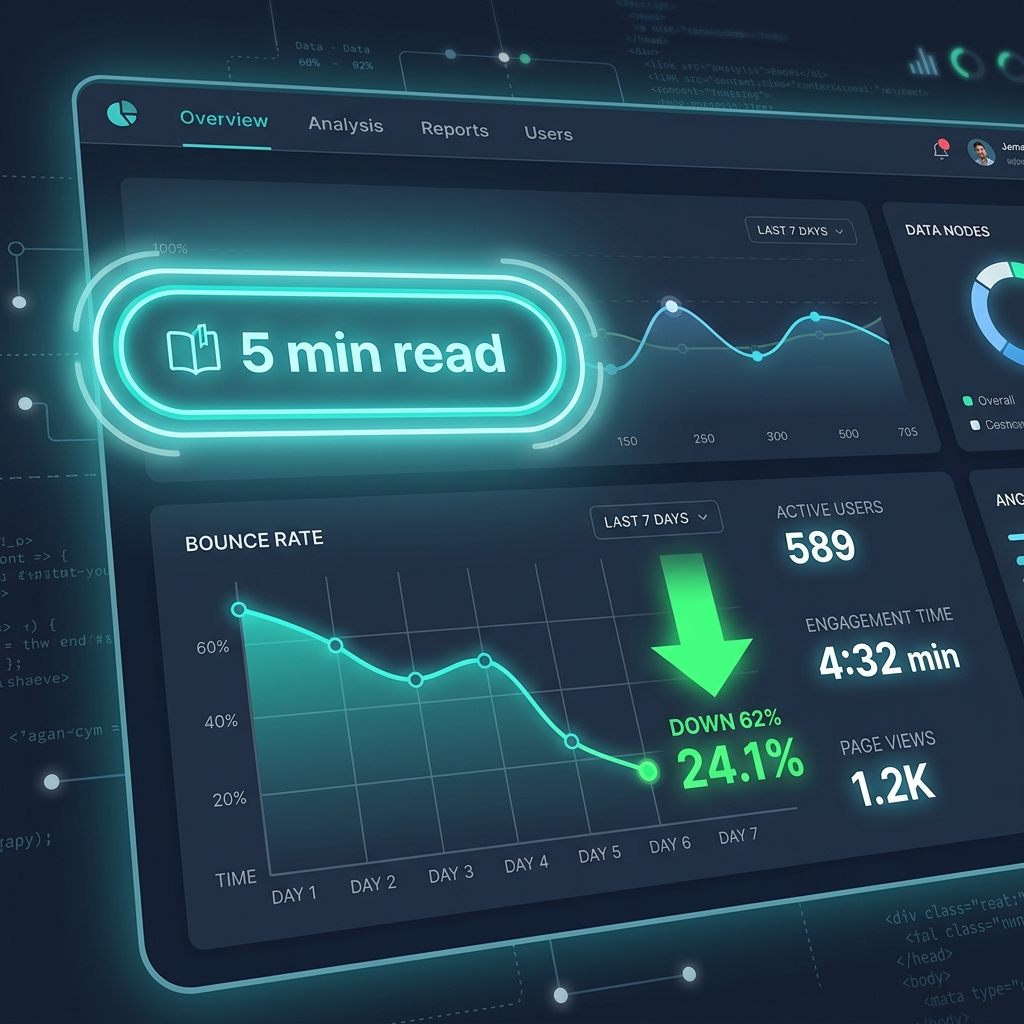
The greatest 'cost' for a modern reader is time, not money. Without a reading time indicator, a user might see a long wall of text and leave immediately (a 'bounce') because the commitment feels too high. By providing a clear'5 Min Read' badge, you set a boundary that makes the task feel manageable, predictable, and respectful of the user's schedule.
Reducing Bounce Rates and Increasing Trust
A high bounce rate signals to search engines that your content failed to satisfy the user's intent. Conversely, adding a reading time estimation builds immediate trust. It shows that you have structured your content with the reader in mind.
Internal data studies show that pages featuring these indicators have up to 20% higher'dwell time.' When users stay on your page longer, it sends a positive signal to Google's ranking algorithms, potentially boosting your organic position for competitive keywords.
How to Calculate Real-World Reading Speed
The standard formula used by top publications (like Medium or The New York Times) assumes an average adult reading speed of approximately 200 to 250 words per minute (WPM). However, this can vary based on content type:
1. **Blogging/Fiction**: 225 WPM. 2. **Technical/Scientific Papers**: 150 WPM (due to increased complexity and data density). 3. **Breaking News**: 300 WPM (focused on skimming).
Our Reading Time Calculator allows you to adjust the WPM slider to match your specific niche. If you write technical tutorials, setting it to a slower pace provides a more honest and helpful estimate for your students.
Implementation: The 20% Rule
When implementing reading time, always round up to the nearest minute. It's better to tell a user it will take 5 minutes and have them finish in 4, rather than the other way around. This 'exceeds expectations' effect leaves the reader feeling successful rather than rushed.
For articles with many images or embedded videos, standard practice is to add an additional 12 seconds per image to the final word-count calculation. This ensures your estimate remains accurate even for visual-heavy content.
Conclusion: A Small Change with Large ROI
In the competitive world of SEO, success is built on marginal gains. Adding a reading time badge is a low-effort, high-impact change that professionalizes your site and keeps your audience engaged. Start measuring your content today and see the impact on your analytics.
Why Using Reading Time as an SEO Strategy to Reduce Bounce Rates is Essential for Modern Workflows
As digital environments become more complex, integrating efficient tools and practices is no longer optional. Concepts related to Using Reading Time as an SEO Strategy to Reduce Bounce Rates form the backbone of productivity for many professionals. Whether you are managing content at scale or just trying to optimize your daily routine, understanding these nuances can save hours of frustration.
Many users overlook the subtle benefits of adopting streamlined processes. By leveraging right strategies, you not only improve speed but also enhance the overall quality of your output. It’s about working smarter, not harder, and making sure your digital footprint is optimized for both users and search engines.
Common Pitfalls and How to Avoid Them
One of the most frequent mistakes people make is relying purely on manual checks. Human error is inevitable, especially when dealing with large volumes of text or complex data structures. Automated tools and standardized guidelines are your best defense against these common oversights.
Another pitfall is inconsistent application of best practices. It is not enough to optimize one piece of content or one project; the rules must be applied universally across your digital assets. Establishing a solid routine ensures that quality never drops, regardless of the workload.
Future Trends to Watch
Looking ahead, the integration of AI and machine learning will further revolutionize how we approach these tasks. However, the foundational principles remain the same. A solid grasp of the basics will ensure you are well-prepared to adapt to new technologies as they emerge.
Stay informed by continuously exploring new tools and updating your skill set. The digital landscape rewards those who are proactive and adaptable. Keep experimenting, stay curious, and always seek ways to refine your approach.